AC essentials

Before you decide, it helps to know

What size air conditioner do you need? Why does it need maintenance? What is R32? A clear, concise guide to choosing and operating the right system for your home with confidence.

What size air conditioner do I need?

The right capacity is key to energy-efficient, comfortable cooling.

There is no single official sizing chart for split air conditioners that everyone uses, but the trade relies on proven rules of thumb. The figures below are practical recommendations for Hungary’s climate, used by manufacturers, retailers and installers alike.

General rule of thumb for living spaces

With normal ceiling height (2.6-2.8 m), average insulation and orientation:

20-25 m²
2.5 kW
9,000 BTU
30-40 m²
3.5 kW
12,000 BTU
45-55 m²
5.0 kW
18,000 BTU
60-70 m²
6-7 kW
24,000 BTU

Good to know

This is a starting point, but it works well in 95% of cases. A site survey is always worth using to confirm the exact capacity.

A more precise method: based on room volume

This is useful for unusual ceiling heights, such as three-metre or loft-like spaces. Multiply the room volume by 40-50 W:

30 m² × 2.7 m = 81 m³ × 45 W = approximately 3.5 kW

When is more capacity needed?

Certain conditions call for an increase over the baseline:

  • +10-30%Poor or weak thermal insulation
  • +10-20%South- or west-facing room
  • +20-40%Large glazed areas or attic space
  • +20-50%Constantly operating IT equipment or heat-generating machinery
  • +1 sizeLarge open-plan room or open kitchen - choose at least one size category higher

An undersized AC

It runs at maximum continuously, leading to high consumption and weak cooling.

An oversized AC

It switches on and off frequently. This weakens dehumidification and can create a draught.

Our method

Capacity (kW) is approximately room volume (m³) × 0.045, then adjusted with the factors above. This results in a stable, economical size.

Why is regular maintenance important?

Five reasons why an annual air-conditioner inspection pays off, and what happens when it is missed.

Clean, healthy air

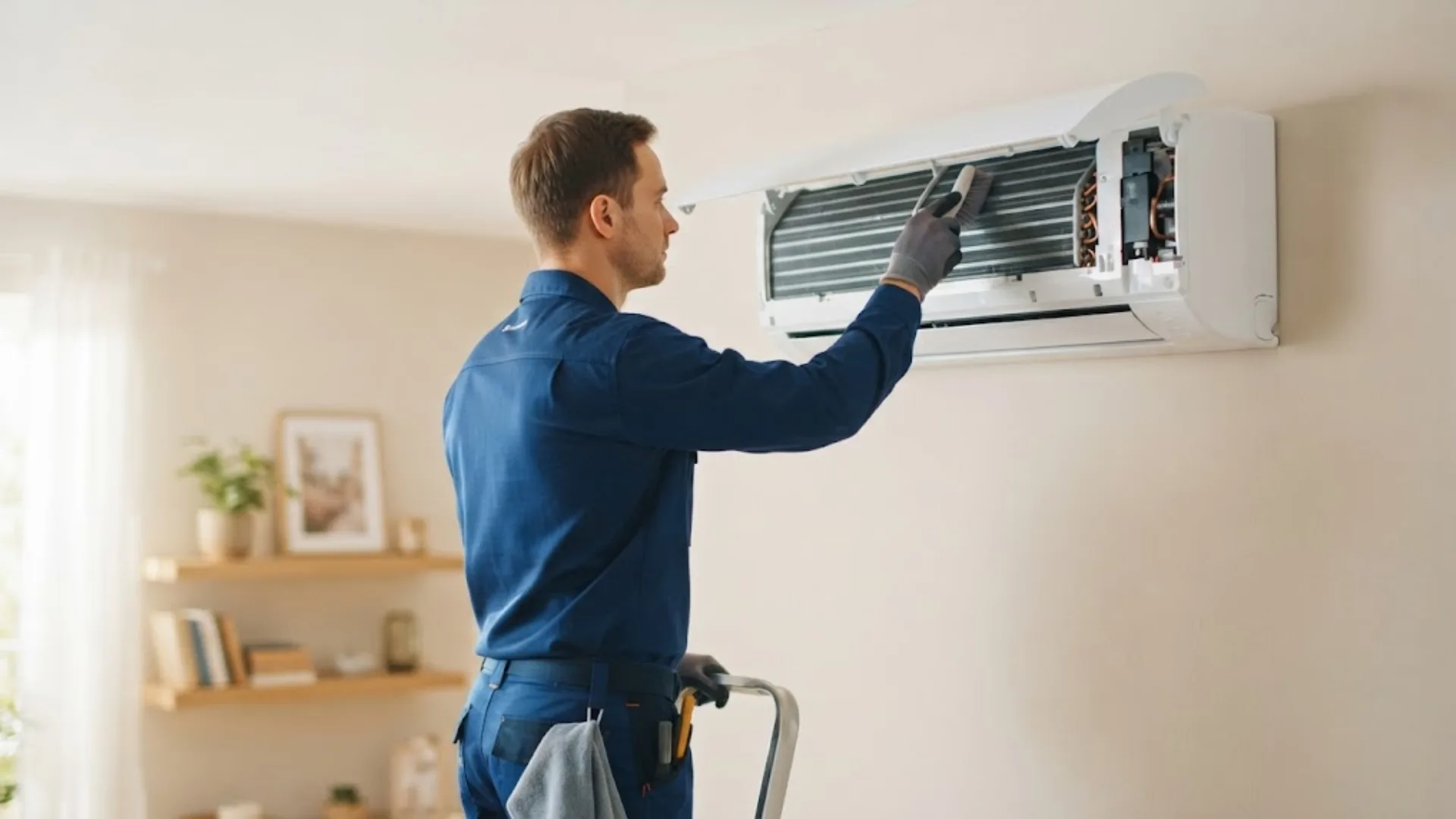
Dust, pollen, mould, bacteria and fungi can easily accumulate on the indoor unit’s heat exchanger, fan and condensate tray. These can cause unpleasant odours, allergy symptoms and respiratory problems. Professional cleaning removes this biological contamination.

“An air conditioner does not cause a cold, but the mould growing inside it can.”

More efficient operation, lower electricity bills

A dirty heat exchanger can reduce cooling and heating efficiency by as much as 10-30%. A maintained unit reaches the desired temperature faster, uses less electricity and runs more quietly.

Depending on model and use, annual savings of HUF 10,000-20,000 are possible.

Longer service life

Without maintenance, the compressor is overloaded, fan bearings become dirty and condensate cannot drain. Regular cleaning and inspection greatly reduce the likelihood of failure, potentially extending operation from 8-12 years to 15+ years.

Warranty and regulatory compliance

Many manufacturers require maintenance by a professional at least once a year. Checking refrigerant level and ruling out leaks are also important under F-gas regulations.

“Without maintenance, the manufacturer’s warranty may be lost.”

Safe operation

During maintenance, the technician checks electrical connections, signs of overheating, the condition of condenser motors and fans, as well as leaks and fittings. This helps prevent fire and electric-shock risks and costly damage.

What happens when maintenance is missed?

Short term · 1-12 months

  • Unpleasant musty AC smell
  • Reduced airflow and weaker cooling
  • Increased electricity use
  • Condensate backing up or dripping
  • Allergy symptoms, scratchy throat or coughing

Longer term · 1-5 years

  • Compressor overload and complete failure
  • Fan bearing failure
  • Refrigerant leak or capillary blockage
  • Mould colonies - a health risk
  • Lost warranty and rising service costs

Recommended maintenance schedule

Residential use

At least once a year

Ideally twice: spring and autumn

Office · shop · continuous operation

2-4 times a year

Based on the level of use

What to remember as a customer:

Regular cleaning saves more electricity than it costs.A cleaned AC is healthier, quieter and lasts longer.Maintenance is also required for the warranty.Annual disinfection can prevent 90% of odours.

Refrigerant essentials

Why is an air conditioner better today than it was 10 years ago?

People do not buy an air conditioner to save the planet. They want a more comfortable, economical and modern home. The good news is that modern technology makes this possible with an ever-smaller environmental impact.

Most people do not choose a new air conditioner because they are interested in the composition of the refrigerant. Comfortable summer cooling, effective winter heating, lower running costs and convenient control matter more. Yet air-conditioning technology has also made huge environmental progress in recent years, alongside becoming more comfortable and economical.

Today’s modern systems:

  • operate with considerably less energy
  • heat with excellent efficiency
  • optimise consumption through smart control
  • improve indoor-air quality with advanced filtration
  • use more modern refrigerants with a lower environmental impact
R32

What is R32?

A significant share of current residential air conditioners uses R32 refrigerant. Its key advantage is a substantially lower global-warming potential (GWP) than earlier-generation refrigerants, while systems still operate highly efficiently. This benefits both the environment and the user: modern technology generally means better performance and lower energy use.

Progress does not stop

The European Union aims to gradually reduce the use of fluorinated greenhouse gases with a high environmental impact. As a result, the industry is already developing next-generation refrigerants. In the coming years, residential air conditioners are expected to use new refrigerants that are even more favourable environmentally.

New technologies also bring new challenges. Some next-generation refrigerants may be more flammable, so their safe use will require specialist design, installation and expertise.

What does this mean in practice?

Buyers have no reason to worry. Just as R32 technology has been safely adopted in everyday life, the entire air-conditioning industry is preparing for new refrigerants. When choosing a modern air-conditioning system today, you are choosing a technology that continues to adapt to future environmental expectations.

In Edison Home’s view, a good solution is comfortable, economical and responsible at once. Modern air conditioning is no longer a luxury item; it is an essential part of an efficient, healthy and future-ready home.
We help you choose the perfect air conditioner

Request a quote